Swarm Robotics
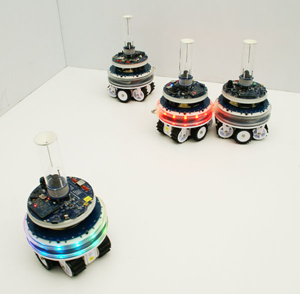
We study the use of swarm intelligence as a tool to develop controllers for swarms of cooperating robots. The principles of swarm intelligence are employed in swarm robotics for the design of robot controllers at the individual level so as to obtain effective swarm-level behavioral strategies. We will focus on swarm behaviors characterized by the coordination and cooperation of the members of a group of robots to accomplish tasks that are beyond the capabilities of a single robot.
Swarm robotics is inspired by the observation of social insects (e.g. ants, termites, wasps and bees) which stand as fascinating examples of how collectively intelligent systems can be generated from a large number of simple individuals. As in their natural counterpart, the robots used in swarm robotics are relatively simple, with local and limited sensing and communication abilities. It is a natural consequence of these individual characteristics that the overall systems are robust against failures of individuals and scalable with group size.
We will work within a scenario in which robots are given a task whose solution requires strict cooperation. We will study how a swarm robotics system can adapt to different tasks, varying environmental conditions, varying numbers and types of robots, and to different levels of malfunctioning of the robots.